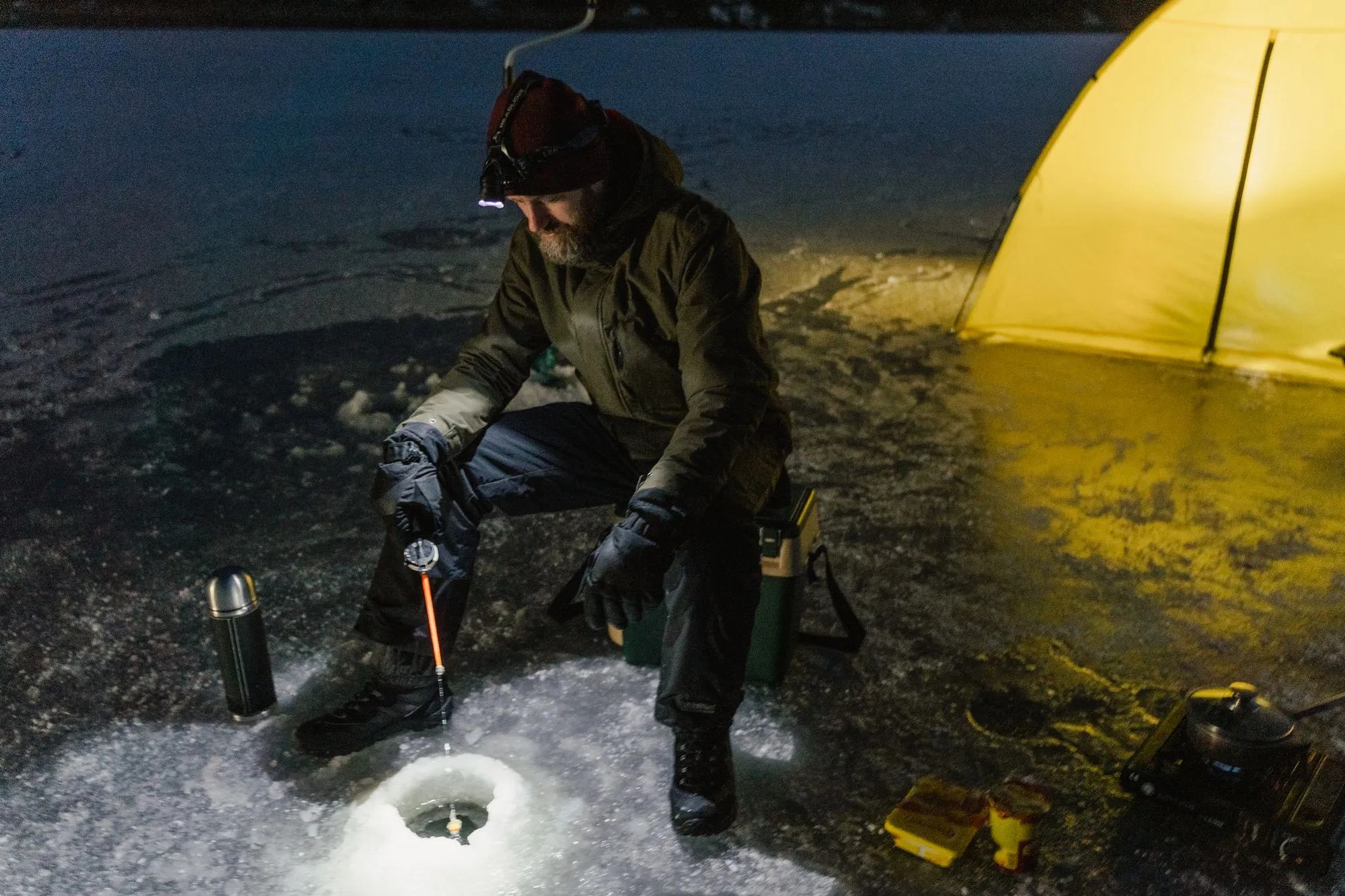
Winter days are short, and the best ice fishing often happens at the edges of them: the last hour of dusk, the first hour after dark, the gray window before dawn. A light dropped through the hole, or hung inside the shelter, does two things at once. It lets you work in the dark, and it pulls fish toward you. Lights do help in ice fishing: most reliably after dark, under snow-covered ice, and for light-responsive species like crappie, perch, and walleye, with the light placed a few feet below the surface and offset from the hole. Anglers have used lanterns and submersible lights on the ice for decades, and the modern LED versions do the job far better than the bulbs that came before.
This guide covers how fishing with lights works, how to set one up, what to look for when you buy, the above-ice and personal lighting that rounds out a night on the ice, and the two things every angler should check before lighting up a frozen lake: the local regulations and the ice itself.
- How fishing with lights works
- Setting up a submersible light
- What to look for in a fishing light
- Above-ice and shelter lighting
- Headlamps and personal lighting
- Underwater cameras, a related tool
- Which fish respond to light
- Setup mistakes to avoid
- Is it legal where you fish?
- Ice safety
- Frequently asked questions
How fishing with lights works
The attraction effect runs up the food chain. A submersible light illuminates the water around it, and that light draws in zooplankton, the microscopic drifting organisms that sit at the bottom of the aquatic food web. Baitfish move in to feed on the concentrated zooplankton. Game fish move in to feed on the baitfish. You are not attracting the walleye or the crappie directly; you are setting the bottom of the chain in motion and letting the rest follow. How strongly that plays out depends on the fish: light-responsive, schooling species like crappie, perch, and walleye come in reliably, while pike and trout respond far less consistently, as covered in the species section below.
Two things make this work better on ice than in open water. The first is the short winter day, which means the productive low-light feeding windows make up a much larger share of the time you are out there. The second is the ice itself. A sheet of ice, especially with snow on top, blocks most ambient light from above, so the water column under the ice is darker than it would be in summer. Drop a light into that dark water and it stands out. The underside of the ice also acts as a reflector, spreading the glow sideways and downward instead of letting it escape upward, which widens the lit zone that fish can find.
Color matters because water filters light. Green is the most popular all-round choice on the ice. It travels well through stained, tannic, or greenish water, and zooplankton respond to it strongly. White light reads more naturally and shows the true colors of your lure, which makes it a good pick in clear water. Blue penetrates deep, clear water but gets absorbed quickly in anything murky, so it is more of a clear-water specialty.
| Water clarity | Best light color | Why |
|---|---|---|
| Clear | White | Reads naturally, shows true lure colors |
| Stained or greenish | Green | Penetrates tannic water, strong plankton draw |
| Deep and very clear | Blue or green | Blue travels far in clear water; green is the safe default |
| Muddy or heavily stained | Green | Best penetration when visibility is poor |
When in doubt, run green. It is the reason most lights sold for the job are green, and it is the color that fails least often across the range of water you are likely to fish.
Setting up a submersible light
The most common mistake is overthinking the depth. Most of the attraction happens in the upper part of the water column, within the first several feet below the ice, because that is where the light is brightest and where the food chain concentrates. You rarely need to drop the light to the bottom. A good starting point is to suspend it a few feet under the ice, or just above the depth you intend to fish, and adjust from there based on where the fish stage.
Placement relative to your hole matters too. Setting the light three to six feet off to the side, rather than directly down your fishing hole, tends to work better. Fish gather around the lit zone and then move to the edge of it to hunt, and your bait sitting at that edge is in a natural feeding lane. A light right on top of your bait can light it up too harshly and put cautious fish off.
Then comes the hardest part, which is waiting. The food chain takes time to assemble. Give a new setup twenty to thirty minutes before you decide it is not working. Anglers who drop a light and expect fish in five minutes usually move too soon. Positioning over structure helps the light do its job: a drop-off, a weed edge, or a point concentrates fish that the light can then pull the last few yards.
What to look for in a fishing light
Submersible ice-fishing lights are mostly inexpensive 12-volt LED units, and the category runs from small 10-to-30-watt lights up to high-output 80-watt-plus models. For ice fishing you do not need the brightest light on the shelf; a modest, efficient unit run in dark water is plenty. The specs worth checking on the current product page before you buy:
- Color. Green for most water, white for clear water, as covered above. Some units offer switchable colors.
- Power draw and runtime. Lower-wattage LEDs sip power and run all night on a small battery. Match the draw to the battery you plan to use.
- Waterproof rating. Look for IP68 or a manufacturer-stated submersible rating for the depth and duration you need. IP68 generally indicates dust-tight protection and immersion protection, but the exact depth and duration are set by the manufacturer, so check the product spec.
- Cord length. A cord of 15 to 30 feet covers most ice depths with slack to spare.
- Power source. Many lights run off a small 12V sealed lead-acid battery; USB-rechargeable and lithium-ion units are increasingly common and far lighter to carry. If you use a separate battery, a deep-cycle or leisure battery is the right choice, not a car starting battery, because deep-cycle batteries are built to be drained and recharged repeatedly.
Durability matters because this gear gets dropped on ice, frozen, and thawed. A solid housing and a strain-relieved cord last longer than the cheapest option.
Above-ice and shelter lighting
Lighting the inside of a shelter is a different job from attracting fish, and it is one the 2019-era guides largely ignored. Modern flip-over and hub shelters from makers such as Otter, Eskimo, Frabill, and Clam often ship with built-in interior LED strips or have them as easy add-ons, usually powered off the same 12V battery that runs your electronics. A lit shelter lets you tie knots, re-bait, and unhook fish without juggling a flashlight in your teeth.
If your shelter does not have built-in lighting, a length of 12V LED strip or a couple of small clip lights wired to a battery does the same thing cheaply. USB-rechargeable lithium power packs have made this simpler, since one pack can run interior lights, charge a phone, and power a flasher for a full day without a heavy battery box. Warm-white interior light is easier on the eyes over a long sit than harsh blue-white.
Headlamps and personal lighting
Some of the most useful light on the ice is the light strapped to your head. Walking out before dawn, drilling holes in the dark, and tending lines at dusk all go better hands-free. A headlamp in the 200-to-450-lumen range is plenty for ice work; you are lighting a hole a few feet away, not a trail across a valley. Established outdoor brands such as Petzl, Black Diamond, Fenix, and Princeton Tec all make solid options.
Two features matter more in winter than the raw lumen number. The first is a red-light mode, which lets you see without wrecking your night vision or spooking fish in shallow, clear water. The second is battery chemistry: lithium batteries hold their voltage in the cold far better than alkalines, which fade fast once the temperature drops below freezing. Keep a spare set warm in an inside pocket.
Underwater cameras, a related tool
An underwater camera is not a light, and it does not replace one. A camera lets you see what is under the ice: whether fish are present, how they are holding, and how they react to your bait. The two dominant brands are Aqua-Vu and MarCum, and current systems range from entry-level units around $300 to flagship models past $1,000, with 7- and 8-inch screens, recording, and color or low-light-optimized sensors.
Cameras and attraction lights complement each other. The light concentrates fish; the camera tells you whether it is working and lets you adjust depth and bait in real time. Plenty of serious ice anglers run both, but a camera is an optional upgrade, not a starting requirement. If you are deciding between the two, a light will catch you more fish for less money; a camera will teach you more about what is happening down there.
Which fish respond to light
Light does not affect every species equally, because not every fish hunts the same way. The fish that respond most reliably are sight feeders that school up.
- Crappie are the classic light-fishing target. They school, they feed up in the water column, and they key on the baitfish that the light concentrates.
- Yellow perch respond well for the same reasons, holding near the lit zone and picking off small prey.
- Walleye are strong responders, especially in low light, which suits their habits as a dusk-and-dark predator.
- Pike respond less consistently. They are ambush hunters and may use the light’s edge, but they are not drawn to it the way panfish are.
- Trout vary by water and by species. In some lakes they come to a light readily; in others they ignore it. Treat trout as a try-it-and-see case rather than a sure thing.
The pattern is consistent: the more a species relies on sight and schooling to feed, the better a light works on it.
Setup mistakes to avoid
Most disappointing nights with a light come down to a handful of avoidable errors:
- Dropping the light too deep. The action is near the surface. A light sitting on the bottom of a deep lake is wasting most of its reach.
- Placing it wrong relative to the hole. Directly under your bait can be too harsh; three to six feet to the side stages fish better.
- Running the wrong color for the water. White in muddy water, or green in gin-clear water, both work against you. Match color to clarity.
- No patience. Pulling the light after ten minutes never gives the food chain time to form. Wait twenty to thirty.
- Fishing dead water. A light concentrates fish that are nearby; it does not summon them from across the lake. Set up over structure where fish already travel.
Is it legal where you fish?
This is the step most often skipped, and it matters. Rules on using artificial light to attract fish vary widely from state to state, and the differences are real. Minnesota and North Dakota both prohibit using a free-standing light to attract fish: Minnesota allows only a lighted lure attached to your line, and North Dakota’s 2026-28 regulations allow artificial light only when it is attached to a lure. Wyoming, by contrast, permits artificial light while fishing. Among states that do allow attraction lights, some still limit color, wattage, or placement, and shelter rules layer on top, with many states requiring an unoccupied shelter to display the owner’s name or carry reflectors after dark. Treat those as illustrations of the range, not a substitute for your own state’s current rule book.
Because these regulations change from season to season, the only reliable move is to check the current rules yourself before you go. Your state fish and wildlife agency, usually called the Department of Natural Resources (DNR), the Department of Fish and Game, or the Department of Environmental Conservation (DEC), publishes the fishing regulations that apply where you fish. Read the section on legal methods and any specific language about lights and shelters.
Backcountry skiers and ice anglers share the same basic principle: read conditions before you commit to terrain. On the snow that means the avalanche forecast; on a frozen lake it means the ice, and the guide to avalanche safety covers the assessment side of that habit.
Ice safety
No fish is worth going through the ice for. Ice is never uniformly thick across a lake; it can be a foot thick in one spot and an inch thick a few yards away, near inlets, outlets, springs, and pressure ridges. The only safe thickness is the one you have measured yourself, and you check it as you go out, not just at the shoreline.
The guidelines below come from the Minnesota DNR, based on its current ice-thickness wallet card.
| New clear ice thickness | What it supports |
|---|---|
| Under 4 inches | Stay off |
| 4 inches | One person on foot, ice fishing |
| 5 to 7 inches | Snowmobile or small ATV |
| 7 to 8 inches | Side-by-side ATV |
| 9 to 12 inches | Car |
| 13 to 17 inches | Truck |
| 20+ inches | Large truck with a wheelhouse shelter |
These ranges apply to new, clear ice. White ice (snow-melted, refrozen, or with air content) is roughly half as strong. Measure as you go and treat the table as a floor, not a ceiling.
A few practices reduce the risk further. Carry a set of ice picks (handheld spikes worn on a cord around your neck) so you can pull yourself out if you do go through. Spread your group out rather than clustering weight in one place. Wear a flotation suit or a life jacket on early and late ice. And know the rescue order if someone else breaks through: do not rush to them and become a second victim. Reach with a pole or branch, throw a rope or anything that floats, and only go onto the ice as a last resort while distributing your weight. Call 911 early; cold water incapacitates a person faster than most people expect.
Frequently asked questions
Do lights work for ice fishing?
Yes, in the right conditions. A submersible light lures in zooplankton and the baitfish that feed on them, and the game fish that feed on the baitfish follow. The effect is strongest in low light, at dusk, after dark, and through snow-covered ice, and it works best on species that feed by sight and school up, such as crappie and perch. It is not a guarantee; it concentrates fish that are already in the area rather than calling them in from across the lake.
What color light is best for ice fishing?
Green is the most popular all-round color because it penetrates stained and tannic water well and strongly attracts zooplankton. White works well in clear water and shows lure colors more naturally. Blue is a reasonable third option in very clear water. The simplest rule is green for stained or greenish water and white for clear water.
How deep should the light go, and how far from the hole?
Most attraction happens within the first several feet below the ice, so you rarely need to drop the light far. A common approach is to suspend it a few feet under the ice or just above the depth you are fishing, and to set it three to six feet to the side of your hole so the fish stage near the light and then move to your bait. Give any setup twenty to thirty minutes before judging it.
Is it legal to use lights for ice fishing?
It depends entirely on the state. Some states allow artificial lights for fishing with few restrictions, some limit color, wattage, or placement, and at least one prohibits introducing artificial light to attract fish at all. Rules change, so check your state fish and wildlife agency (often called the DNR, Department of Fish and Game, or DEC) for the current regulations before you go.
Do I need an underwater camera as well as a light?
No, they do different jobs. An attraction light draws fish toward your spot; an underwater camera lets you watch what is down there and how fish react to your bait. Many anglers run both, but a camera is an optional addition rather than a replacement for a light.
The short version
Run a green submersible light in stained water and white in clear water, keep it in the upper few feet of the column and a few feet off to the side of your hole, and give it twenty to thirty minutes to pull the food chain together. Light the inside of your shelter off the same battery, keep a lithium-powered headlamp for the walk out and the drilling, and add an underwater camera later if you want to see what the light is doing.
Then handle the two things that are not optional: confirm your state allows what you are about to do, and measure the ice on your way out. For the gear that keeps you upright on it, see the best ice cleats for ice fishing roundup, and the rest of the Snow & Ice section covers the wider world of cold-weather pursuits beyond the slopes.
Product categories and ice-safety figures in this guide were verified against current sources in June 2026, with ice-thickness guidance from the Minnesota DNR. Regulations and product specs change; confirm your state’s current fishing rules and any product’s current specification before you rely on them. If you find an error in this guide, please email [email protected].