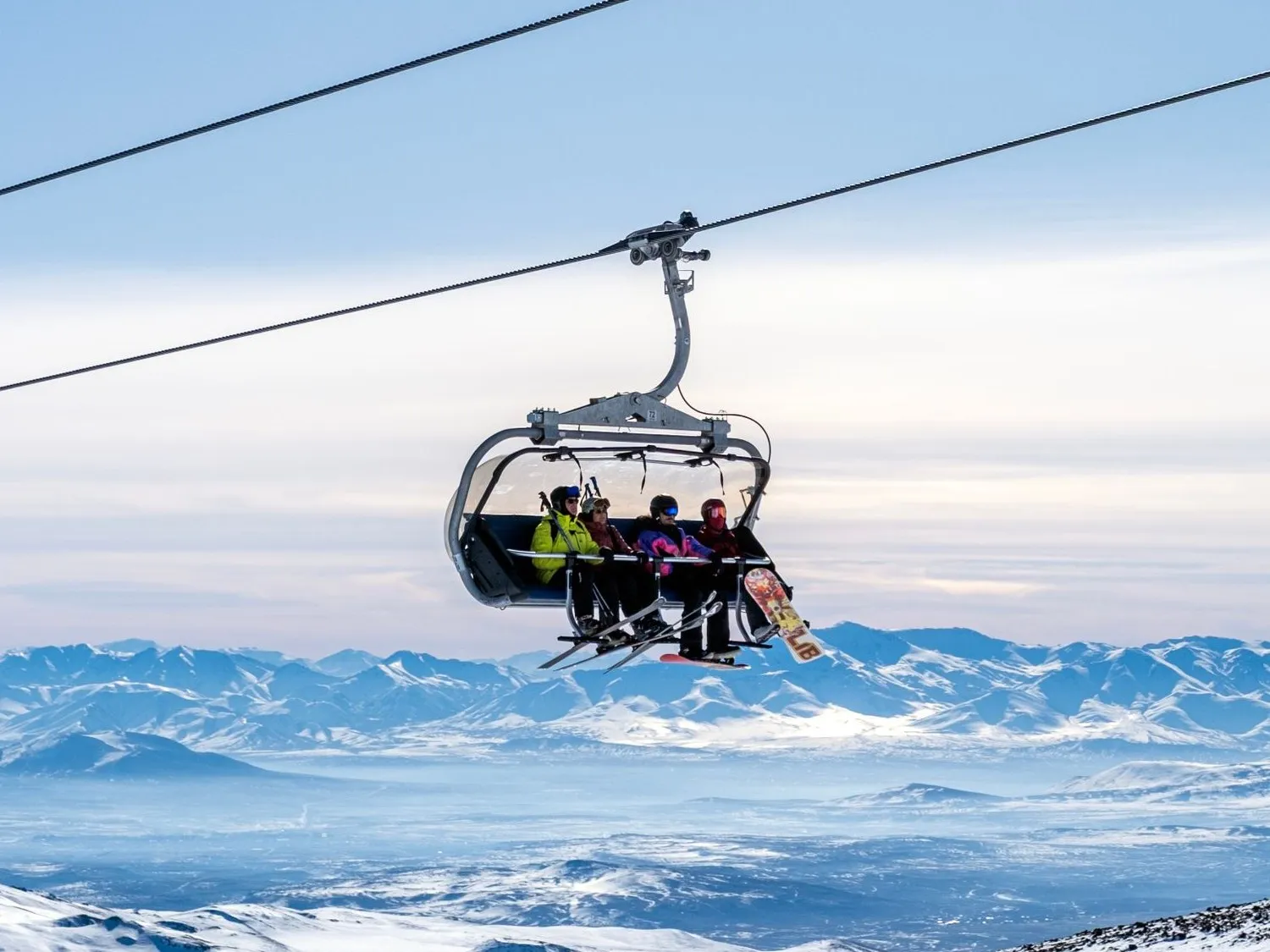
You spend a lot of time on lifts. This is not a complaint. The ride up is when you catch your breath, plan the next line, or stare into a valley and remember why you drove five hours to get here. But the machine you are riding shapes the whole day: how many runs you get, how cold you get on the way, and whether the mountain is even turning when the wind kicks up in the afternoon.
Most lifts look like variations on the same thing until you know what to watch for. Here are the main types of ski lifts you will ride at a US resort, and what to know about each one before you get in line.
Magic carpets
The gentlest lift on the mountain, and the one almost everybody starts on. It is a rubber conveyor belt set flush into the snow: you slide on with your skis or board still on, stand there, and it carries you up the bunny slope. Nothing to grab, nothing to time. You will find one at the learning area of basically every resort, from Loveland’s Rainbow carpet in Colorado to the smallest local hill. Keep your knees soft, step off at the top, and that is the whole thing. It moves at a crawl.
Rope tows
The older, cheaper cousin: a moving loop of rope, or a handle-tow version like Mad River Glen’s Callie’s Corner tow, that you grab and hold while it drags you uphill. You will find them at small local hills, learning areas, and the occasional pull at an old-school mountain. Grab firmly, keep your knees soft, and let the rope pull you instead of muscling up it; the effort lands in your hands and forearms and tires you out faster than it looks. Watch out for grabbing too late and getting yanked, or dropping the rope halfway and sliding back into the person behind you. Both are rites of passage.
T-bars and poma lifts
Ancient tech that survives because it works. A metal T hangs off a moving cable and tucks behind the thighs of two riders to drag them up; a poma is the single-rider version, with a round platter between your legs. You will find them at older mountains and a handful of New England hills; Waterville Valley in New Hampshire still runs T-bars, and small hills and touring areas keep them because they are cheap and keep spinning in wind that closes the chairs. The one rule: stand, do not sit. The bar tows you while you stand on your skis; it does not carry you. Sit down and it drops you, and you slide back down the hill on your face in front of a lift line of New Englanders watching in silent judgment. On skis you will have it within a run or two. On a snowboard it is a genuine first-day trial, ridden at an angle with your back foot out of the binding, and if your weight goes wrong you wash out sideways into the trees. Everybody has done it. It is the price of the mountain.
Fixed-grip chairs
The classic open chair, clamped permanently to the cable so the whole line runs at one steady speed, including through the station where you load. You will find them everywhere, but especially at smaller, older, or budget-minded mountains. Mad River Glen’s Single Chair, the famous one-seater in Vermont, is fixed-grip and beloved precisely because it is slow and old. To load, shuffle to the line, look back, and let the chair scoop you up; do not lunge. Bar down, tips forward. Watch the load if you are new, because it does not slow down and arrives at full speed. Sit as it comes; if it knocks you off balance, the operator can stop the lift, and nobody remembers by the next run.
High-speed detachable chairs
The workhorse of the modern resort. The chair unclamps from the moving cable at each end, slows to a walking pace so you can load in comfort, then re-grips and hauls up the line at up to 5 meters per second, roughly 11 miles per hour, according to Doppelmayr. That is what “high-speed” means, and a “high-speed quad” or “six-pack” on the trail map is one of these. You will ride them as the main lifts at most destination resorts across the Rockies. The thing to watch is the false confidence: the slow load lulls you, then the chair accelerates hard as it grabs the main cable, so get your bar down before that, not after.
Bubble chairs
A high-speed chair with a clear dome that folds down over you, sometimes over heated seats. Okemo in Vermont runs the Sunburst Six, a bubble six-pack with heated seats. You will find them at destination resorts spending on creature comforts. Load like any chair, then pull the bubble down once you are in. Nothing to watch out for here; this is the one lift that is strictly nicer than it needs to be, and on a raw day you will fight for a spot on it.
Gondolas
When the lift seals you in a cabin, everything gets calmer. A gondola seats four to 15 in a car you walk into, gear in the outside rack, out of the wind. You meet them at bigger mountains, usually as the lift out of the base or a summit connector: Heavenly’s gondola in Tahoe and Killington’s K-1 in Vermont are two well-known ones. Take your skis or board off, slot them in the rack, walk in, sit down. The thing to watch is the rack on the way out, because everyone’s black skis look alike and grabbing the wrong pair is a classic. As for the giant tricable “3S” gondolas you may have read about, the ones carrying up to 38 people a cabin, none run at a US resort; the closest is Whistler’s Peak 2 Peak, over the border in Canada.
Aerial trams
The rare, dramatic one. One or two big cabins hang from thick cables and shuttle back and forth, counterbalanced so one rises as the other drops. Only a handful of serious mountains run them: Jackson Hole in Wyoming lifts 100 riders plus an operator to the top in about nine minutes; Snowbird in Utah runs two cabins in counterbalance; and Big Sky in Montana’s Lone Peak Tram carries two 75-passenger cabins with glass panels in the floor, if you dare look down. Pack in, grab a strap, take the view, and mind the last-tram time, since trams load on a schedule, not continuously. Watch what waits at the top: a tram usually reaches steep alpine terrain no chair could climb to, often with gates into unpatrolled backcountry where the avalanche risk is entirely your own to manage.
Chondolas
One lift that alternates open chairs and enclosed gondola cabins on the same cable, so you take whichever comes around. Only a few resorts run them: Beaver Creek’s Centennial in Colorado and Sunday River’s chondola in Maine are the US classics. Take the cabin if you are cold or wrangling kids, take the chair if you just want the next thing moving. Watch which carrier is coming and commit early, because the chair and the cabin load a little differently.
When the wind shuts it down
Wind is the thing most likely to wreck your plans, and lifts do not all fold at the same gust. The giant trams are, surprisingly, among the hardiest, their cabins hung from thick track cables so they barely sway. High-speed detachables are among the first to stop, since gusts disrupt the grip clamping on and off at the terminals and open chairs swing; fixed-grip chairs hang on longer, and surface lifts, down on the snow, keep towing after everything overhead has quit. Monarch Mountain in Colorado publishes that sustained winds over 50 mph start putting lifts on hold and over 70 mph close all of them. Check the lift status before you drive, because a mountain built around high, exposed chairs shuts down on days a wind-hardy one keeps spinning.
What “uphill capacity” means for your line
Resorts rate a lift by how many people it moves an hour: a surface lift maybe 1,200 to 1,500, a fixed-grip chair 2,400 to 2,800, a high-speed detachable or gondola 3,600 to 4,500. A tram moves the fewest, 500 to 2,000, because it shuttles instead of circulating. It is why the same wait feels different at different lifts: 20 minutes at a six-pack is a packed day; at an old fixed-grip double it is a normal Saturday.
What the lift mix tells you
Read a trail map and the lifts sketch the mountain before you buy a ticket. Mostly fixed-grip and surface lifts means a place that is small, old-school, or spending its money somewhere other than uphill speed, and some of the best mountains in the country are exactly that. High-speed detachables and a gondola mean a resort spending to clear the base fast. A tram means terrain worth building a tram for. None of it says whether you will have a good day; it tells you, before you click in, what will shape it.