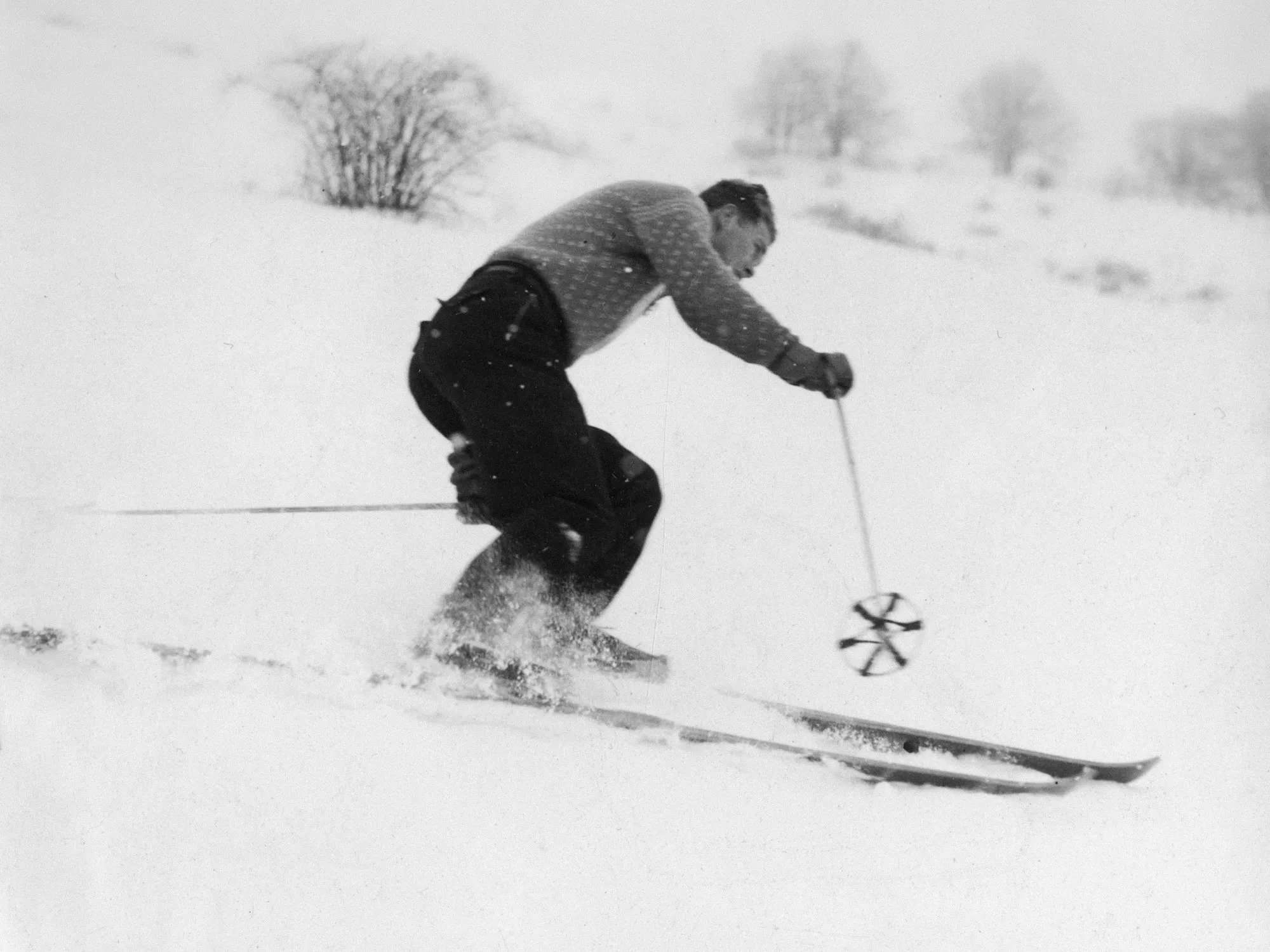
Here is something to chew on next time you are stuck on a slow fixed-grip double: the thing you are doing is old. Not lift-served-resort old. Thousands-of-years old. For most of its history skiing was how people survived winter, and the sliding-downhill-for-fun part we treat as the whole point is a very recent bolt-on.
It started as a way to get around
Before it was a sport it was how you got across frozen country without sinking to your waist. In 2014 a pair of skis with the leather bindings still attached melted out of a glacier in Norway’s Reinheimen mountains, roughly 1,300 years old and the best-preserved ancient skis ever found. Older still is the picture carved into rock: at Rodoy in northern Norway there is a stick figure on skis scratched into stone thousands of years ago, old enough that when Norway hosted the 1994 Winter Olympics at Lillehammer they built the Games’ logo around it. The Ski Museum in Holmenkollen, which opened in 1923 and is the oldest ski museum in the world, frames its collection as 5,000 years of skiing history. Five thousand years. Your season pass is a rounding error.
The people who did it first
The early skiers were not athletes, they were hunters and travelers. The ancestors of the Sami people, across the far north of Norway, Sweden, Finland, and Russia, skied for hunting and transport for thousands of years, moving over the snow after reindeer with skis and sleds. Skiing was infrastructure, and it stayed that way for a very long time.
How it turned into a sport
The shift from tool to sport ran through one Norwegian in particular. Sondre Norheim, born in 1825 in Morgedal in the Telemark region, is the name to know. He rebuilt the gear so it could be steered: heel bindings that held the boot to the ski, and skis cut narrower at the waist than at the tip and tail, the side-cut that lets a ski turn instead of just point downhill. He won an early national skiing competition in Christiania, now Oslo, in 1868, and the turn he made famous still carries the name of his region. Every time someone drops a Telemark turn on the hill, that is Morgedal, more than 150 years later. Norheim emigrated to the US in 1884, which is a fair segue, because skiing was already crossing the Atlantic.
How it got to America
It came over in the 1850s with Norwegian immigrants, and the first great American skier had a mail route. Snowshoe Thompson, born in Telemark and raised in the Midwest, turned up in California in 1852 for the Gold Rush and ended up carrying the mail on skis. For about twenty years he ran roughly 90 miles each way over the Sierra Nevada, from Placerville, California to Genoa, Nevada, on homemade oak skis close to ten feet long, through storms that stopped everyone else. He was never paid by the federal government for it, which tells you something about both the man and the government.
Meanwhile the gold camps had found racing. Miners in the Sierra towns, places with names like Poker Flat, La Porte, and Johnsville, strapped on “longboards” and pointed them straight down the hill, no turning, just a greased board and nerve. By 1860 they had clubs with elected officers and written rules, and the fastest of them were clocked at speeds reported near 90 miles an hour, chasing cash prizes that ran as high as a thousand dollars in silver. This was competitive downhill racing in America half a century before the first chairlift, and almost nobody remembers it happened.
Then the machines showed up
The piece that turned skiing into the industry you buy a ticket to arrived in January 1934, on Clinton Gilbert’s farm outside Woodstock, Vermont. It was a loop of rope, about 1,800 feet of it, dragged around by the engine of a Model T up on blocks, hauling skiers up a 900-foot slope for a few dollars. It was the first ski tow in the United States, per the Vermont Historical Society, and it changed the whole thing, because for the first time you could ski down without the misery of climbing back up. Every high-speed six-pack and gondola on the mountain today is a descendant of that Model T and that rope.
The long view
So when was skiing invented? The honest answer is that it was not invented so much as slowly repurposed. It was a survival tool for thousands of years, a Norwegian obsession that grew into a sport in the 1800s, a gold miner’s adrenaline habit in the Sierra, and finally, less than a century ago, a thing with a lift and a lodge and a parking lot. Next time you ride up, you are the latest person in a 5,000-year line who decided strapping boards to their feet was a good idea. Most of them had a better excuse than you do.