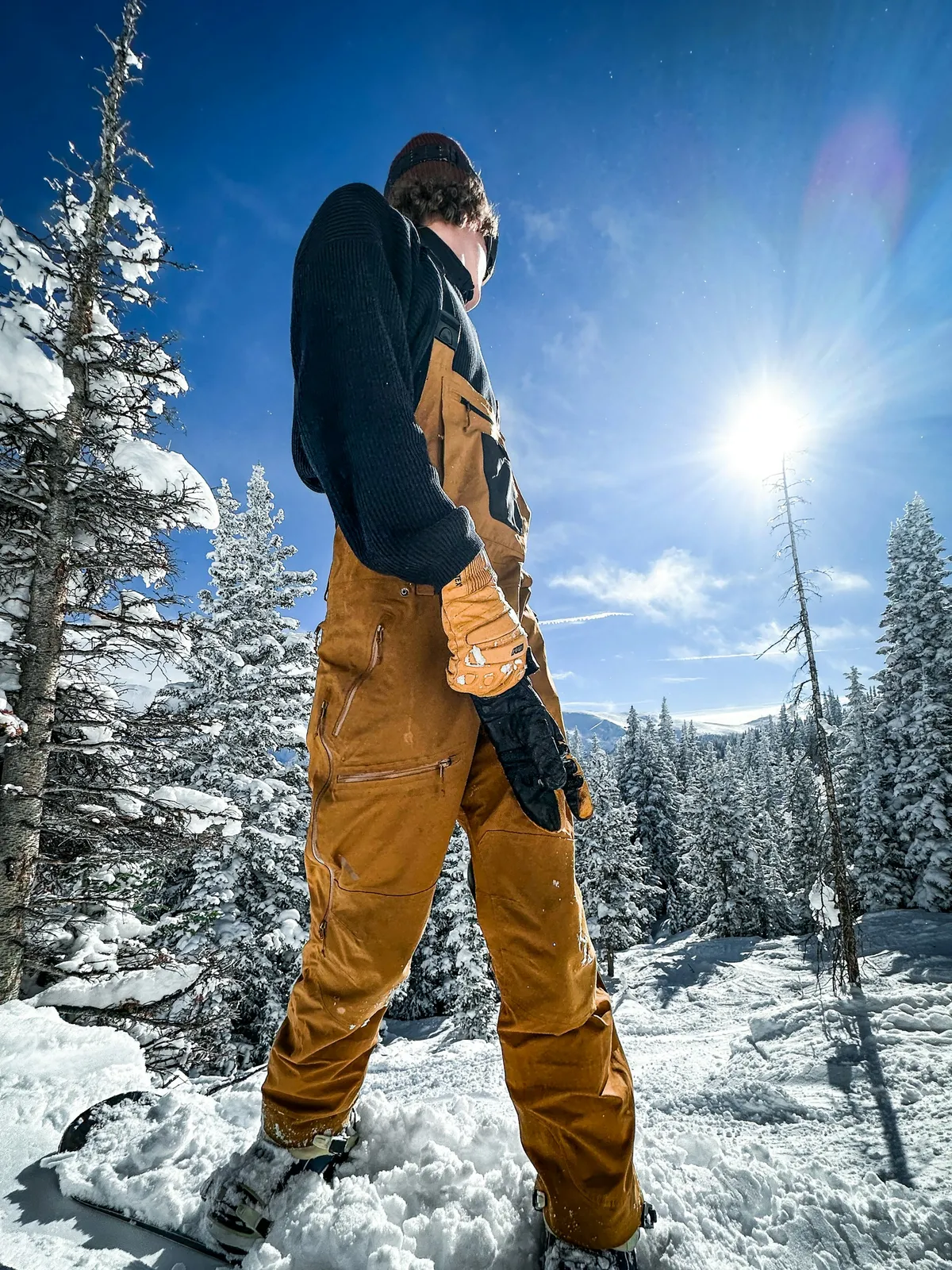
Sit down to fasten your bindings and your jacket rides up. If that leaves a strip of base layer exposed to the snow, you can see the appeal of bibs immediately. They extend above the waist, so there’s more overlap when you bend, sit, or take a tumble.
Pants are simpler to get in and out of and leave less fabric around your torso. If yours stay secure and your jacket covers them when you move, you may already have everything you need.
The choice comes down to the coverage and fit you want, plus a less glamorous detail that’s worth checking before you buy: getting to the bathroom.
What changes when you wear bibs?
Bibs use shoulder straps and a raised upper section instead of relying on a waistband alone. Some rise high at both the front and back; others have a lower back or a stretchy upper section. Look at both sides of the garment when shopping online.
That extra coverage is useful if snow tends to find its way under your jacket. It also changes the fit. Pants mainly need to work around your waist, hips, seat, and legs. Bibs need to fit the length of your torso as well.
| What matters to you | Pants | Bibs |
|---|---|---|
| Coverage when sitting or bending | Depends on the jacket overlap and waistband staying put | Raised upper section adds overlap |
| Keeping the garment secure | Waist adjustment or a belt | Shoulder straps, sometimes with waist adjustment |
| Less fabric around your torso | Usually the simpler choice | Upper section sits beneath your jacket |
| Bathroom breaks | Familiar waist opening | Check the fly, side opening, or drop seat |
| Fit | Check waist, seat, knees, and length | Check all of those plus torso length |
Do bibs keep you warmer?
They cover more of your torso, but that doesn’t make every bib warmer than every pair of pants. An insulated pair of pants may provide more warmth through the legs than an uninsulated bib. Check the fill rather than choosing by shape alone.
If you tend to get hot, pay attention to the upper fabric and leg vents. Try opening the vents with your jacket on. An opening you can’t easily reach is less helpful when you want to cool down between runs.
Your base layer matters too. Before replacing pants because you’re cold, consider what you’re wearing underneath and whether the insulation suits your day.
Don’t skip the bathroom check
A fly, a long side zipper, and a drop seat offer different kinds of access. Check which one the bib has and how it works with your layers. You don’t want to discover on the mountain that a tucked-in top blocks the opening, or that you need to remove your jacket and straps every time.
Try the sequence at home with clean clothing and the tags still attached. Can you reach the zipper? Do the straps stay where you need them? Does the opening give you enough access?
If you prefer the familiar simplicity of undoing a waistband, that’s a perfectly good reason to choose pants. A feature you use several times a day deserves as much attention as a fabric specification.
Fit them while sitting down
Fasten the pants or adjust the bib straps, then sit and reach toward your boots. With pants, notice whether the waist slides down or digs in. With bibs, watch for pulling at the shoulders or crotch.
If a bib feels too short through the torso, going wider won’t necessarily solve it. Tightening the straps to lift long legs can create the opposite problem. Short or tall lengths, where available, may suit you better than changing the overall size.
Wear your snowboard boots when checking the hems. You need room over the boots without loose fabric ending up beneath your heels. Our jacket and pants fit guide walks through the rest of the fitting.
Can you mix jacket and pants brands?
Yes, provided the garments fit together comfortably. Check the overlap while seated and try the powder skirt if you use one. Nothing should bunch painfully around the waist.
If you want to connect the jacket to the pants, check the actual attachment system on both pieces. Don’t assume two garments connect just because their labels match.
Where the choice gets less obvious
Warm spring riding
A bib’s upper section is extra fabric beneath your jacket. If you usually run warm, look at how high it rises, whether that upper fabric is breathable or stretchy, and how easy the leg vents are to use. Pants leave the torso less covered, but thick insulated pants can still be too warm. Compare the actual fill and fabric before choosing by shape.
A long torso or shorter legs
Bibs connect the shoulders to the lower half, so the same size needs to work in two directions. If the crotch pulls upward while the legs are already too long, sizing up may add more unwanted leg length. Try a different torso cut or a short-leg option where one exists. Pants let you choose the waist and leg fit without the shoulder-to-crotch constraint.
Riding with a backpack
Put the pack on during the fitting. Bib buckles and straps can sit beneath shoulder straps; a waist belt can press over a pant waistband or block pockets. Check those contact points with your usual load. A bib can solve a slipping waistband yet introduce a new pressure point higher up.
Changing layers during the day
Try removing your midlayer without disturbing the bib straps. Then test the bathroom opening with your base layer tucked the way you normally wear it. A drop seat can be convenient, but only if the rest of the outfit leaves it usable. If the sequence feels awkward at home, cold hands and a small restroom stall are unlikely to improve it.
A wet seat after sitting in snow
Extra waist coverage helps with snow entering from above. It doesn’t repair a leaking seat seam or change the waterproof fabric below it. Before replacing pants with bibs, work out where the moisture enters. Otherwise you could buy more coverage and keep the same problem.
Which would make your day easier?
Choose bibs if you’re tired of adjusting your waistband or want more coverage when you sit and bend. Choose pants if you’re happy with the overlap you already have and prefer a simpler fit around your torso.
Once you’ve decided, compare insulation and price within that shape. Start with pants under $200 or pants from $200 to $299, and compare them with bibs under $300 if extra coverage appeals. The better choice is the one that lets you get on with riding without repeatedly adjusting your clothes.